
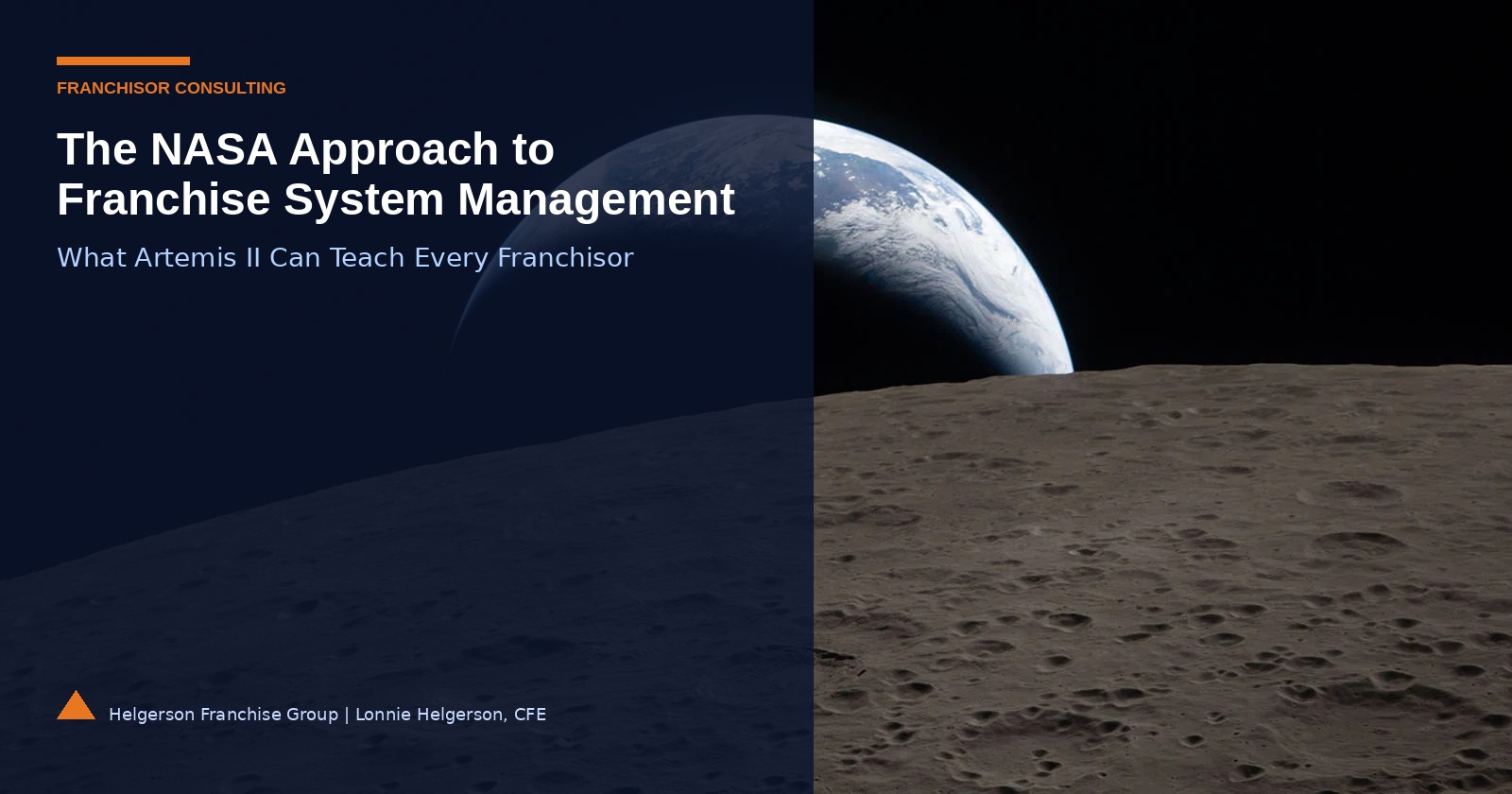
On April 1, 2026, NASA launched four astronauts aboard the Orion spacecraft — named Integrity by the crew — on a 10-day mission around the Moon and back. Artemis II flew 694,481 total miles, carrying its crew farther from Earth than any humans in over 50 years, splashing down safely off the coast of San Diego on April 10.
Not one thing was left to chance.
Every system was tested. Every contingency was mapped. Every person on that team — from Mission Control in Houston to the recovery crews in the Pacific — knew their role, their checklist, and their backup plan. The result was a mission that NASA’s Artemis program manager called a triumphant success.
That’s not luck. That’s what Rule No. 9 from my book Five Pennies is all about: Manage your system like NASA would.
What Does That Actually Mean for a Franchisor?
NASA doesn’t wing it. They don’t rely on talented people to figure it out as they go. They build systems, validate those systems, test them under stress, and then trust the systems — not just the individuals running them.
Most emerging franchisors do the opposite. They have a great business, a great product, maybe even great franchisees — and they rely on those individuals to hold everything together. That works until it doesn’t.
When one strong franchisee exits. When a key support person leaves. When you hit 15 units and the informal communication that worked at 5 units collapses. That’s when the cracks show.
During the Artemis II mission, the crew experienced a planned 40-minute communications blackout as the spacecraft passed behind the Moon — and Mission Control had already mapped exactly what to do during that window. Nothing stopped. Nobody panicked. The system held.
Your franchise system needs to be built the same way.
The Four NASA Principles That Apply Directly to Franchise Management
1. Checklists exist for a reason — use them.
NASA’s pre-launch checklist for Artemis II was thousands of items long. Your franchise operations manual is your checklist. If franchisees aren’t following it — or if it doesn’t exist in a form people can actually use — your mission is already at risk.
2. Every system gets tested before it goes live.
Artemis II’s primary goal was to validate Orion’s systems, crew operations, and mission procedures ahead of sustained lunar exploration in future missions. Before you award your next franchise, have you stress-tested your training program? Your supply chain? Your grand opening support? Don’t find out what breaks by letting a franchisee discover it.
3. No single point of failure.
NASA builds redundancy into everything — redundant communication systems, redundant power, redundant abort protocols. Your franchise system needs redundancy too: in field support, in vendor relationships, in leadership. If one person leaving cripples your operation, you don’t have a system. You have a dependency.
4. You measure what matters.
Mission Control tracked thousands of data points in real time throughout Artemis II. What are you tracking across your franchise system? Unit-level profitability. Franchisee satisfaction. Brand standard compliance. If you’re not measuring it consistently, you’re flying blind.
The Honest Truth About Most Emerging Franchisors
The majority of franchise systems I see — and I’ve been doing this for over 35 years — are built on the founder’s energy and tribal knowledge. That’s how every great business starts. But franchising is the act of packaging that knowledge so someone else can replicate it without you in the room.
That’s the mission. And like any mission worth attempting, it requires more than good intentions. It requires a system built for the long haul.
“Franchisee profitability is the most important mission of the franchisor.”
— Fred DeLuca, President & Co-Founder, SUBWAY®
NASA didn’t bring those four astronauts home safely by hoping for the best. They built the system that made success the most likely outcome. Your franchisees deserve the same.
If Your Franchise System Isn’t Built Like NASA, Let’s Fix That
At Helgerson Franchise Group, we work with emerging and established franchisors to build the operational infrastructure, support systems, and accountability frameworks that turn good franchise concepts into Mega-Brands. The Ten Rules from Five Pennies aren’t theory — they’re the playbook. If you’re ready to manage your system with the precision it deserves, let’s talk.
About Lonnie Helgerson, CFE
Lonnie Helgerson is a Certified Franchise Executive, IFA Board Member, 2-time Past Chairman of the VetFran Committee, and author of Five Pennies: Ten Rules to Successfully Build a Franchise Mega-Brand. He has spent over 35 years advising franchisors and franchisees nationwide through Helgerson Franchise Group.